
Traffic violations can come with far-reaching repercussions aside from fines or a trip to court. Based on the type of violation and location, some violations might appear on your driving record for years. Your driving record could impact everything from insurance rates to licensing issues and further penalties related to traffic. Knowing How Long Do Traffic Violations Stay on Your Record will allow you to take appropriate action following a violation citation. From receiving a speeding ticket or gaining points against your driving record, being aware of your driving record could help prevent further repercussions.
How Long Do Traffic Violations Stay on Your Record?
Each violation has its own time limit that varies based on various factors. The period of visibility will depend on state legislation, the nature of the infraction committed, and driver history, among other elements.
- Minor violations: Some infractions like speeding and disregarding traffic lights might appear on the record for a certain number of years. The exact timeline differs according to the regulations set out in each jurisdiction.
- Serious offenses: More severe offenses will appear for much longer and will have an impact on whether or not an individual qualifies for a license, receives employment, or pays high premiums.
- Record timelines: Infractions might appear on an official record for different periods compared to how long they will matter to court rulings and insurance providers.
Consequently, understanding How Long Do Traffic Violations Stay on Your Record is challenging since there are numerous variables involved in each case.
What Determines How Long a Traffic Violation Stays on Your Record?
In the case of how long traffic violations stay on your driving record, it’s necessary to keep in mind some factors. First, you’ll want to know how a state motor vehicle department deals with tickets according to the official procedure; however, the real-life effects will depend on various circumstances.
- Offense severity: A speeding ticket will have different consequences compared to driving under suspension or being charged with reckless driving.
- Local laws: Every state has unique laws regarding how driving offenses must be recorded and counted in points.
- Driving history: Prior incidents might lead to harsher penalties rather than a single one-time mistake.
- Final disposition: A dismissed or amended charge will matter differently compared to a guilty verdict or admission.
There are no universal answers because states and individual cases differ greatly. Drivers who wonder how long their own records last will benefit from consulting a local motor vehicle department or contacting an attorney.
How Long Do Common Traffic Violations Stay on a Driving Record?
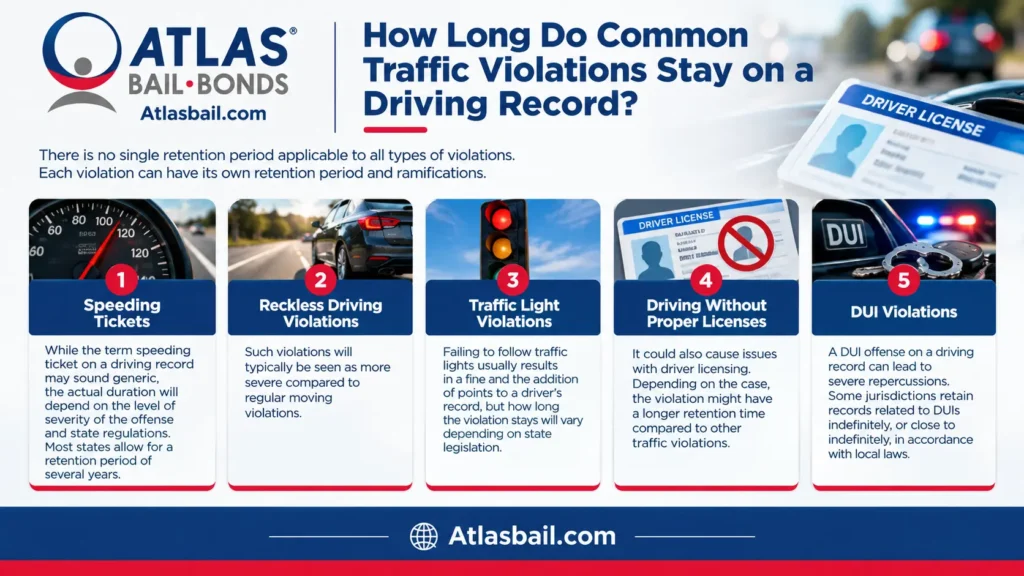
There is no single retention period applicable to all types of violations. Each violation can have its own retention period and ramifications.
- Speeding tickets: While the term speeding ticket on a driving record may sound generic, the actual duration will depend on the level of severity of the offense and state regulations. Most states allow for a retention period of several years.
- Reckless driving violations: Such violations will typically be seen as more severe compared to regular moving violations.
- Traffic light violations: Failing to follow traffic lights usually results in a fine and the addition of points to a driver’s record, but how long the violation stays will vary depending on state legislation.
- Driving without proper licenses: It could also cause issues with driver licensing. Depending on the case, the violation might have a longer retention time compared to other traffic violations.
- DUI violations: A DUI offense on a driving record can lead to severe repercussions. Some jurisdictions retain records related to DUIs indefinitely, or close to indefinitely, in accordance with local laws.
How Do Points Affect Your Driving Record?
Driving record points are a tool employed by states to document some types of traffic offenses. Exceeding the limit of points during a certain time period will bring penalties ranging from warning letters to higher premiums, license suspension, and others.
Points vary by violation: There are varying numbers of points assigned depending on the seriousness of the offense.
The quantity matters: Committing several offenses in close succession might cause stricter penalties than committing just one isolated offense.
Time periods apply independently: The timeline for which points impact your driver’s license differs from that of the violation itself.
Penalties for licenses: Once the total number of points reaches a particular state-defined level, there could be repercussions on the driver’s license.
When wondering how long do points stay on your license? be sure to refer to the latest point system rules for your specific state because they vary greatly.
Can Traffic Violations Affect Your Insurance?
Yes. Traffic violations and insurance are often connected because insurers may review driving history when determining risk and premiums. But having a traffic ticket doesn’t mean the consequences will apply equally to all drivers’ insurance policies.
- Premium surcharges: Some types of tickets could trigger surcharges on insurance premiums, especially those demonstrating increased levels of danger while operating a vehicle.
- Ticket seriousness counts: Severe tickets or patterns of traffic violations can carry more weight than minor violations.
- Varying insurer guidelines: Every insurance company operates under different underwriting criteria and takes various approaches regarding traffic violation evaluations.
- Driver awareness: It’s essential to recognize that the duration of a violation entry within an official driving record won’t always correspond precisely with the insurer’s evaluation period.
Can You Reduce or Clear a Traffic Violation From Your Record?
It’s worth mentioning that, in some cases, drivers might be able to mitigate the consequences of a violation or get themselves a clean driving record after a traffic violation.
- Questioning the citation: If you think that you were cited unjustly, you could be able to dispute the citation in court.
- Traffic school: Certain places give drivers a chance to enroll in traffic classes that would help lower the number of points accumulated.
- Time lapse: After waiting out the necessary retention period, your violation or points wouldn’t be relevant anymore.
If a driver faces severe accusations, he/she might benefit from getting professional bail bond services provided by AAA Atlas Bail Bonds. For legal advice, talk to an experienced lawyer.
Frequently Asked Question (FAQ)
How long do traffic violations stay on your record?
It depends on both state laws and specific violations. While most violations will stay on your record for only a few years, serious violations could result in even longer-lasting penalties.
Does a traffic ticket stay on your record after you pay the fine?
Payment clears you of any financial responsibility associated with the violation but will not always remove the violation from your driving record.
How long do points stay on your driver's license?
They differ based on states and specific types of violations. Refer to your state's Department of Motor Vehicles' regulations.
Can a traffic violation affect your car insurance?
Yes. Insurance providers might use the violation when determining your driving risk level and premium rates.
Can you remove a traffic violation from your driving record?
Sometimes. Whether you qualify for dismissal or traffic school programs is determined by your state's rules and the circumstances of each case.

Author Bio
Julianna Morgan and Ethel Rangel are co-owners of AAA Atlas Bail Bonds, a family-owned Texas bail bond company that has been helping families navigate the bail process since 2009. Together, they have years of hands-on experience assisting clients with jail releases, bail bond requirements, court procedures, payment options, and the complexities of the Texas criminal justice system.
Through their work serving Dallas, Irving, Farmers Branch, Denton, and surrounding communities, Julianna and Ethel have helped thousands of families during difficult situations. They are committed to providing accurate, practical, and easy-to-understand information about bail bonds and the jail release process in Texas.
Reviewed By Statement
Co-Owners, AAA Atlas Bail Bonds
This article was reviewed by Julianna Morgan and Ethel Rangel, co-owners of AAA Atlas Bail Bonds, to help ensure the information is accurate and relevant to Texas bail bond clients.
Disclaimer
The information provided in this article is for general informational purposes only and should not be considered legal advice. Bail laws, court procedures, and regulations may change and can vary by jurisdiction. For legal advice regarding your specific situation, consult a licensed attorney. For questions about bail bonds or jail release services in Texas, contact AAA Atlas Bail Bonds directly.