

If a person has been released on a bail bond and they do not come to court when their case is called, the responsibility for that goes beyond the person who was released. So this is where bounty hunters come in to play as part of the bail bond industry. Knowing what a bounty hunter is, how terms of service operate, and how they assist the bail bond company will give you a better understanding.
What Is a Bounty Hunter?
Bounty hunters are persons hired by the bail bond companies to locate and apprehend individuals who fail to show up in court after being granted a bail bond. The goal is to return the individual to the appropriate authorities so that the bail bond company can recover its losses and/or minimize its risk of loss.
In many circumstances, bounty hunters must obtain a license or certification prior to being able to engage in fugitive recovery work, depending on the jurisdiction where the individual is being pursued, as well as the state in which they reside.
The Role of Bounty Hunters in the Bail Bonds Industry
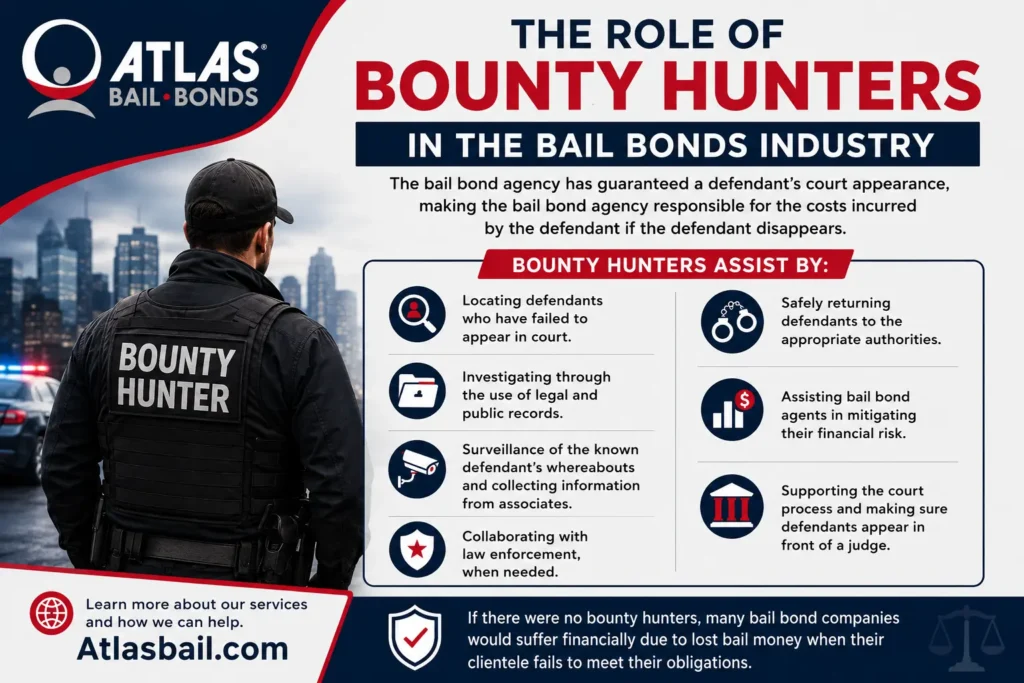
The bail bond agency has guaranteed a defendant’s court appearance, making the bail bond agency responsible for the costs incurred by the defendant if the defendant disappears.
Bounty Hunters Assist by:
– Locating defendants who have failed to appear in court.
– Investigating through the use of legal and public records.
– Surveillance of the known defendant’s whereabouts and collecting information from associates.
– Collaborating with law enforcement, when needed.
– Safely returning defendants to the appropriate authorities.
– Assisting bail bond agents in mitigating their financial risk.
– Supporting the court process and making sure defendants appear in front of a judge.
If there were no bounty hunters, many bail bond companies would suffer financially due to lost bail money when their clientele fails to meet their obligations.
Read more: Role of Bounty Hunters

Bail Bond Information
Responsibilities of a Bail Bond Agent
The functions of a bail bond agent and a bounty hunter are different from each other.
The duties of a bail-bond agent include:
- Explain to the defendant and family how the bail process works.
- Evaluate if the defendant is qualified to receive a bail bond.
- Prepare contracts and legal documents.
- Collect any premiums or collateral as needed.
- Make sure the client understands court obligations.
- Monitor the defendant during the term of the bail bond.
- Work with recovery professionals if the defendant absconds (does not show up for court).
The primary duty of a bail-bond agent is to secure the defendant’s release and help the client with their court obligations. If a defendant violates their responsibility, the bail-bond agent may enlist a bounty hunter for the recovery of the individual.
How Do Bounty Hunters Work?
Receive the Assignment
When a defendant does not show up for court, professionals will verify the defendant’s failure to appear, after which they will contract with a bounty hunter for the recovery of the defendant.
Conduct an Investigation
The bounty-hunter will compile as much information about the defendant as possible, including:
- The last known address.
- Employment history.
- Family and friends associated with the defendant.
- Any social media activity (subject to state law).
- Vehicle information.
- Available public record information.
Locate the Defendant
The bounty hunter will investigate various means, including surveillance, interviewing, and utilising state and county databases to locate the defendant.
Apprehend the Individual
If the state allows it, the bounty hunter may detain the defendant for a reasonable amount of time until he can return the defendant to law enforcement or the court.
Complete Documentation
Following the recovery, the bounty hunter will submit a report to the bail-bond company and any necessary legal authorities to complete the recovery process.
Legal Limitations of Bounty Hunters
Bounty hunters typically have varying degrees of authority in various states, but they must abide by applicable law.
Some common legal limits include:
- Following applicable state licensing laws.
- Using only lawful methods of investigation.
- Not using excessive force.
- Following applicable laws relating to private property.
- Working together with local authorities, where needed.
- Following any order issued by a court or any applicable state laws.
Why Bail Bond Companies Depend on Bounty Hunters
When a bail bond company posts a bond on behalf of a defendant, it is financially responsible for that bond. If the defendant fails to appear as required, the company could lose money equal to the total amount of the bond.
Bounty Hunters help bail bond agencies in many ways by:
- Decreasing operational losses.
- Increasing the number of defendants that appear in court.
- Recovering defendants expediently.
- Creating a safer community.
- Protecting the agency’s interests.
- Encouraging accountability among defendants.
Due to the many benefits associated with their use, bounty hunters continue to be a valuable resource for many bail bond companies.
With AAA Atlas Bail Bonds, rest assured that all your bail bond needs will receive the support needed to ensure a successful outcome.
Bounty Hunter vs. Bail Bond Agent: What’s the Difference?
| Feature | Bounty Hunter | Bail Bond Agent |
|---|---|---|
| Primary Role | Locate defendants who skip bail | Arrange bail bonds for defendants |
| Main Objective | Return fugitives to custody | Secure release from jail |
| When Involved | After missed court appearance | Before the defendant is released |
| Works For | Bail bond company | Bail bond agency |
| Daily Duties | Investigation, surveillance, recovery | Paperwork, client consultation, payment processing |
| Law Enforcement Officer | No | No |
| Financial Responsibility | Recovery assistance | Issues and manages bail bonds |
Frequently Asked Question (FAQ)
What do bounty hunters do?
Bounty hunters have many responsibilities in regard to locating those who are wanted and apprehending them. It can include locating them if they are wanted or conducting surveillance to find out what they are doing.
What are bounty hunters allowed to do?
They do not have police powers, but will act according to state statute as it relates to their investigation of wanted individuals.
Are bounty hunters law enforcement?
No! While bounty hunters do have certain powers as a result of being licensed, their power varies by state and is subject to local laws.
Can bounty hunters arrest people?
In some states, bounty hunters may legally apprehend defendants who have skipped bail. However, their authority is limited by state laws and differs across jurisdictions.
What rights do bounty hunters have?
Bounty hunters have rights, such as the right to locate an individual who has failed to appear for a court appearance and to apprehend the individual if they are located and if local laws allow for it.
Key Insights
- Bounty hunters are hired to capture defendants who fail to show for their court date once they have posted bail.
- After bail is paid by bail bond companies, bounty hunters are hired to locate and recover fugitives.
- Bounty hunters are regulated by state laws governing what they are allowed to do.
- Experts work with bail bond agencies to mitigate financial loss and improve accountability.
- By knowing how bail and bonding processes work, defendants will be able to avoid any issues with the legal system.

Author Bio
Julianna Morgan and Ethel Rangel are co-owners of AAA Atlas Bail Bonds, a family-owned Texas bail bond company that has been helping families navigate the bail process since 2009. Together, they have years of hands-on experience assisting clients with jail releases, bail bond requirements, court procedures, payment options, and the complexities of the Texas criminal justice system.
Through their work serving Dallas, Irving, Farmers Branch, Denton, and surrounding communities, Julianna and Ethel have helped thousands of families during difficult situations. They are committed to providing accurate, practical, and easy-to-understand information about bail bonds and the jail release process in Texas.
Reviewed By Statement
Co-Owners, AAA Atlas Bail Bonds
This article was reviewed by Julianna Morgan and Ethel Rangel, co-owners of AAA Atlas Bail Bonds, to help ensure the information is accurate and relevant to Texas bail bond clients.
Disclaimer
The information provided in this article is for general informational purposes only and should not be considered legal advice. Bail laws, court procedures, and regulations may change and can vary by jurisdiction. For legal advice regarding your specific situation, consult a licensed attorney. For questions about bail bonds or jail release services in Texas, contact AAA Atlas Bail Bonds directly.