

Atlas Bail Bonds Locations Near You

Blue Warrant

What Is a Blue Warrant, and How Can a Bail Bond Agent Help?

When the issue of a blue warrant arises, it is quite easy for victims’ families to experience confusion and worry about what actually constitutes a blue warrant and under which circumstances it is used. Therefore, knowing what a blue warrant is and understanding one’s options can enable one to respond effectively to the issue. It is where AAA Atlas Bail Bonds comes in to help. We provide necessary bail bond information on all aspects of the process of obtaining bail in Texas.

What Is a Blue Warrant?

To get clarity on the matter of a blue warrant, it is important to understand that it is a kind of warrant that is issued by the Texas Board of Pardons and Parole, acting on the assumption that the mentioned individual has violated the conditions of parole or mandatory supervision. Unlike a standard criminal arrest warrant, the blue warrant in the Texas case has nothing to do with the criminal conviction; it addresses only the issue of violation of parole.

If a Texas parole warrant is out on an individual, the law enforcers will have to take measures to arrest that individual and ensure that he/she is kept behind bars till the time of the parole board meeting.

Here are some of the common reasons for which a blue warrant may be issued:

  1. Failing to keep appointments with a parole officer
  2. Testing positive for consuming drugs/alcohol
  3. Going out of an approved boundary
  4. The individual is being arrested for a new criminal case.
  5. If any court-imposed orders are violated
  6. Not finishing required therapy or treatment sessions.

It is crucial to learn about the blue warrant process because the formalities differ from those of other criminal cases.

What Happens When a Blue Warrant Is Issued?
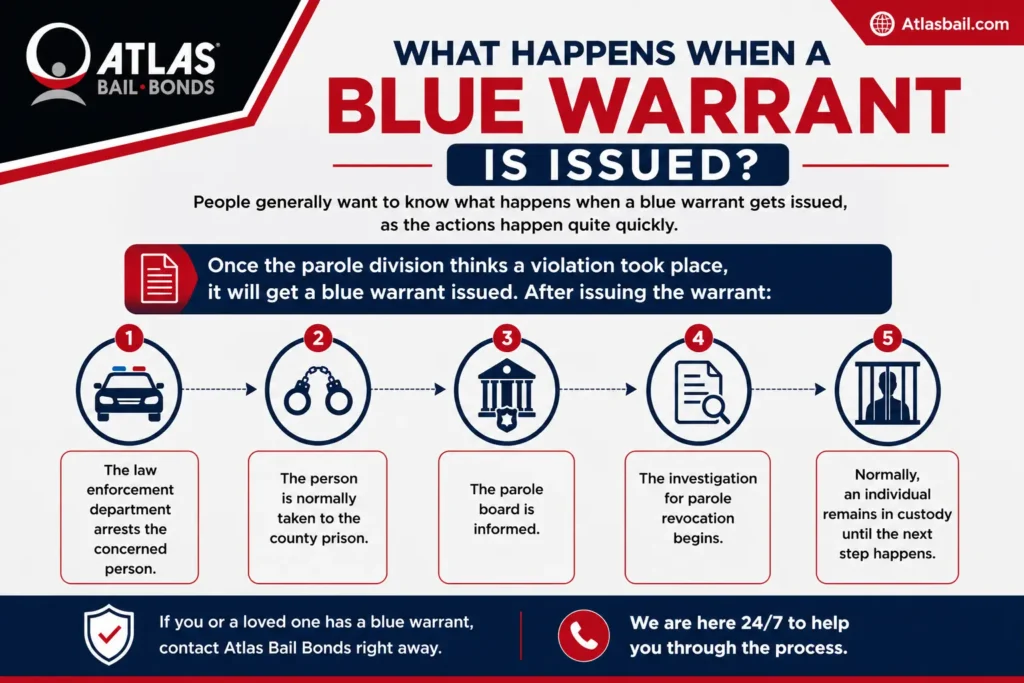
What Happens When a Blue Warrant Is Issued

People generally want to know what happens when a blue warrant gets issued, as the actions happen quite quickly.

Once the parole division thinks a violation took place, it will get a blue warrant issued. After issuing the warrant:

  • The law enforcement department arrests the concerned person.
  • The person is normally taken to the county prison.
  • The parole board is informed.
  • The investigation for parole revocation begins.
  • Normally, an individual remains in custody until the next step happens.

Understanding Blue Warrant Parole Violations

A blue warrant for parole violation doesn’t necessarily mean a revocation of parole. It starts the verification period in which the parole authorities will investigate the probable violation in question.

The most common technical violations are:

  • Absenteeism
  • Violating the curfew timeline
  • Failing to inform about changes in employment
  • Skipping counselling sessions
  • Traveling without permission

On the other side of the spectrum, there are serious violations composed of:

  • Getting arrested on felony charges
  • Committing violent acts against someone
  • Selling drugs
  • Usage of firearms

The seriousness of the violation influences how the parole authorities will handle the issue.

Can You Bond Out on a Blue Warrant?

In many blue warrant Texas cases, the answer is no, at least initially.

Blue warrants differ significantly from conventional criminal charges because they hold the individual in custody until the Texas parole authorities may decide whether to cancel the warrant or continue with parole violation proceedings.

  • Whether the Blue Warrant remains active
  • The status of the withdrawal of the blue warrant by the parole board
  • Whether there are any fresh criminal charges involved
  • Court rulings regarding the new charges are involved.

Despite being challenging to be released on bail due to the existence of a blue warrant, making inquiries to an expert on bail bond agents for blue warrants might prove useful in clarifying the course of action.

How to Remove a Blue Warrant?

The cancellation of the warrant cannot take place through the mere act of paying a sum of money or posting a bond.

In fact, the cancellation process usually consists of:

  1. Re-examination of parole conditions and relevant issues by parole officers.
  2. Conducting an inquiry regarding the circumstances that led to the violation.
  3. Preliminary hearing, if applicable.
  4. Conducting a hearing for the revocation of parole.
  5. Making a ruling by the parole board.

At times, the following rulings can be made by the board:

  • The warrant is withdrawn.
  • The individual is returned to parole.
  • Additional parole conditions are imposed.
  • Parole is revoked.
  • Continued incarceration.

The Blue Warrant Process Explained

Step 1: Alleged Violation

A parole officer receives information suggesting a parole violation.

Step 2: Blue Warrant Issued

A Texas parole warrant is authorized.

Step 3: Arrest

Law enforcement locates and arrests the individual.

Step 4: Jail Detention

The person remains in custody while parole authorities investigate.

Step 5: Review or Hearing

Parole officials review evidence and determine whether revocation proceedings should continue.

Step 6: Final Decision

The parole board decides whether parole continues or is revoked.

The time frame differs depending on the case and the evidence at hand.

Are you seeking answers with respect to blue warrants? Contact AAA Atlas Bail Bonds for information about how bail works, including opting for alternatives, and help with the fast bail paperwork for every bond that is legally obtainable.

Blue Warrant vs. a Regular Arrest Warrant or Bench Warrant

Feature Blue Warrant Regular Arrest Warrant Bench Warrant
Primary Purpose Alleged parole violation New criminal offense Failure to appear or obey a court order
Issued By Texas Board of Pardons and Paroles Judge Judge
Applies To Individuals on parole Anyone accused of a crime Individuals who violate court requirements
Bail Availability Often limited or unavailable while active Frequently available, depending on charges May be available depending on circumstances
Hearing Process Parole revocation review Criminal court process Court appearance required
Focus Parole supervision Criminal prosecution Court compliance

Frequently Asked Question (FAQ)

Blue warrants are special types of warrants that can be issued only in Texas in case of parole violations or mandatory supervision.

In most cases, it is impossible to obtain bail when a blue warrant is still valid. However, each situation can be different, and some additional charges may be included.

No. The blue warrant is applied where a person has been accused of breaching the terms of his or her parole, while ordinary arrest warrants often relate to new criminal conduct.

A Blue Warrant is processed by the Texas parole system under the jurisdiction of the Texas Board of Pardons and Paroles once a report of a suspected parole violation is filed.

It stays active until the parole system determines its rescission, internally solving the issue.

Key Insights

Author Bio

Julianna Morgan and Ethel Rangel are co-owners of AAA Atlas Bail Bonds, a family-owned Texas bail bond company that has been helping families navigate the bail process since 2009. Together, they have years of hands-on experience assisting clients with jail releases, bail bond requirements, court procedures, payment options, and the complexities of the Texas criminal justice system.

Through their work serving Dallas, Irving, Farmers Branch, Denton, and surrounding communities, Julianna and Ethel have helped thousands of families during difficult situations. They are committed to providing accurate, practical, and easy-to-understand information about bail bonds and the jail release process in Texas.

Reviewed By Statement

Co-Owners, AAA Atlas Bail Bonds

This article was reviewed by Julianna Morgan and Ethel Rangel, co-owners of AAA Atlas Bail Bonds, to help ensure the information is accurate and relevant to Texas bail bond clients.


Our Team - AAA Atlas Bail Bonds → Last reviewed: July 2026
Disclaimer

The information provided in this article is for general informational purposes only and should not be considered legal advice. Bail laws, court procedures, and regulations may change and can vary by jurisdiction. For legal advice regarding your specific situation, consult a licensed attorney. For questions about bail bonds or jail release services in Texas, contact AAA Atlas Bail Bonds directly.

Share this post